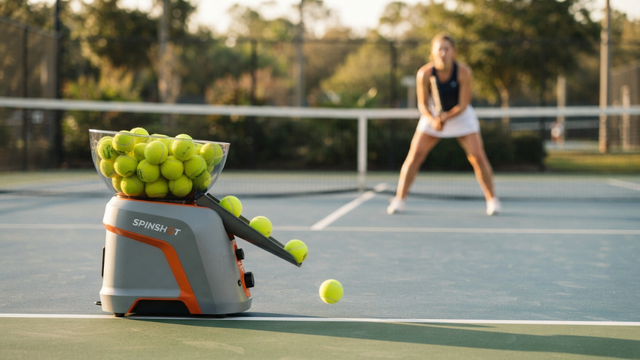
Deciding whether to invest in a pickleball ball machine usually comes down to a fairly practical question: how often is a lack of a partner actually preventing practice? For players who find themselves skipping sessions simply because no one else was available, a machine addresses that specific bottleneck directly.
Useful features vary depending on what a player is trying to accomplish. Someone working purely on consistency and basic contact needs different capabilities than someone drilling advanced dinks and third-shot drops under fatigue. Adjustable speed, spin, and shot type selection matter more for advanced players; simple, reliable feeding at a steady pace matters more for beginners building fundamentals.
Technical considerations worth evaluating before purchase include ball capacity, battery life, portability, and whether the machine supports app or voice control. A machine that requires manual resetting after every ten balls, for instance, will produce a very different practice experience than one built for extended, uninterrupted sessions. For a broader look at how these features compare across different price points, the full lineup at Tenniix is a reasonable starting point for comparison shopping.
Player profile matters more than it might seem. A player practicing alone in a driveway or at an empty community court has different priorities than a coach using a machine for group clinics. The former usually values portability and simple setup; the latter often benefits more from higher ball capacity and varied drill programming to keep multiple students engaged during a session.
Cost is naturally part of this evaluation. Entry-level machines offer a lower barrier to consistent practice without the more advanced tracking features found in premium models. For players unsure whether they'll use a machine consistently, starting at a lower tier and evaluating usage before upgrading is often a more sensible approach than committing to the most feature-rich option immediately.
Maintenance and durability are also worth factoring into a purchase decision, even though they're easy to overlook in the excitement of comparing features. Equipment used outdoors regularly is exposed to sun, moisture, and dust, so checking build quality and warranty terms upfront can save considerable frustration and expense down the line compared to discovering these issues after a season of use.
Ultimately, the value of any training machine comes down to whether it actually gets used. A feature-rich but complicated machine that sits in a garage after a few sessions provides less value than a simple, reliable one that becomes part of a regular routine.
Reading reviews and asking current owners about real-world usage patterns, rather than relying solely on manufacturer spec sheets, often reveals practical details that matter more day-to-day than headline features — things like how noisy a machine is during operation, or how easy it actually is to reload balls mid-session without pausing for several minutes.
It's also reasonable to factor in how a machine will be used beyond just solo practice. Players who occasionally host friends for group hitting, or who plan to eventually use the machine for coaching younger family members, may want to prioritize higher ball capacity and simpler controls that non-owners can operate easily, rather than optimizing purely around solo, advanced-feature use.
Return and warranty policies are also worth reviewing carefully before finalizing a purchase, particularly for a first-time buyer unsure whether a specific model will actually suit their playing style once tested on an actual court rather than just read about online. A reasonable trial or return window can meaningfully reduce the risk of an expensive purchase that ultimately doesn't fit a player's needs.
FAQ
What's the biggest factor in choosing a pickleball machine? Matching the machine's features to actual practice goals — consistency drilling versus advanced shot variation — matters more than any single spec.
Do beginners need an AI-tracking machine? Not necessarily. Simple, adjustable feeding is often sufficient for players still building fundamental consistency.
How long do these machines typically last with regular use? Durability varies by build quality and usage frequency, so checking warranty terms and battery replacement options is worth doing before purchase.
Should outdoor storage conditions affect the buying decision? Yes, players who store or use their machine outdoors regularly should prioritize weather-resistant build quality and check warranty coverage accordingly.
Comments